Showing posts with label TGWOH. Show all posts

November 21, 2018

The Great War of Hind - free Audiobook

Vaibhav Anand
Free Audiobook

The Great War of Hind (Legend of Ramm #1) is now part of Audible trial. Simply sign up for a free 1 month Audible trial and you can listen to the audiobook version for absolutely free!

Click here to listen for free now: https://amzn.to/2DzXCvj

September 25, 2018

The Great War of Hind - now free with Amazon Prime


The Great War of Hind (Legend of Ramm #1) is now part of Prime Reading. If you are an Amazon Prime member, you can read the ebook for absolutely free!

Click here to read for free now: https://amzn.to/2zrc2LG 

August 27, 2016

The Great War of Hind: Ongoing deals on Amazon

Great War of Hind paperback version available for Rs. 99 only. Kindle version for Rs. 26

Link: http://amzn.to/2bWvzao

April 22, 2016

An interview with e-Books India (Transcript)

Please tell us about you. Where are you from? What is your professional background and how did you become an author?
I am an MBA from FMS, Delhi and an engineer from Delhi College of Engineering. I have actually held a day job for the last six years since I graduated from FMS. I wrote my first book in the second year of B-School: the intention was to tell the B-School story no one was talking about – the unglamorous murky truth of how the premier league MBA ecosystem in India almost collapsed when the 2008 global recession hit. And well, I had always wanted to write ever since I read my first Famous Five book what seems like aeons ago.

To a lot of authors, the dream is to write a bestseller and retire. While I had flirted with the thought initially when my first book came out six years ago, I eventually realized that a classical author’s job is lonely, depressing and dark. You basically sit in a room waiting in despair for the right idea, the right words, and the right characters to come to you. I doubt I will ever be a full time author – as it is, I can hardly write when I am at peace or with time on my hands. The best ideas always come to me when I am pressed for time; it is the constant grind of life that makes me an author, for the most part.

What types of books do you write?
It often takes a very different technique to write different kinds of books – which is why most science fiction writers only write science fiction, comedy writers only write comedy, mystery/thriller writers only write mystery/thrillers and so on; for the most part anyway. I grew up on a diet of all kinds of books, all of which I secretly wished I had written – and what I have discovered overall about myself is that I tend to be fairly ambidextrous when it comes to writing. I just need to train for a particular style if required. Training takes months but primarily involves reading the masters of that genre and noting their techniques. You learn a lot from masterpieces but you learn more from bad books from the masters of a particular genre. For example, one of the books in the Harry Potter series (the 4th book if my memory serves me right) or Douglas Adam’s Dirk Gently series are both written by masters but have significant flaws compared to the authors’ earlier works. For an author like me, it is absolute gold to read mediocre to bad books by great authors… it’s like seeing an elaborately constructed building with the foundations and the wiring showing; it just makes understanding how to write the genre much easier.

My natural voice is cynical, which is where the first book ‘If God Went to B School’ fit in. Over time as I started reading satirical articles on Faking News a few years back, I discovered that I could easily slip into satire writing (which led to my 300+ posts for Faking News so far). But reading the novelized history of the Mughals (by the husband-wife duo going by the pseudonym ‘Alex Rutherford’) made me realize I wanted to write historical fiction. I enjoyed the books so much that I wanted to write that genre! Which is how ‘The Great War of Hind’ was born.
I remain perennially besotted with sci-fi comedy too; inevitably, I will write a book or a series in this genre. Maybe a few years down the line.

Can you please tell us a bit about your most recent book entitled The Great War of Hind, its overall plot and the key characters in it?
The overall idea of the book is around how we believe epics written by Valmiki and Ved Vyas to be about Gods and real men. To me, Valmiki and Ved Vyas were the Stan Lee’s of their generation, who wrote these stories to regale people. In parallel, I had been toying with a simple logical idea of creation – God creating man and animals – and I saw no better way to tell the story than to pick mythological characters everyone knows and plug them into a story of the origin of mankind and animal-kind and how and why it all happened, and what happened after. ‘The Great War of Hind’ and ‘The Legend of Ramm’ series are built around this kernel.

Are you working on any other book(s)? If so, can you please tell us what we can expect to see from you in the future?
Well, I am sort of obligated to finish this series (Legend of Ramm) now that I have started it. So that will be a couple of years of my life at least. Unless something else catches my fancy next, I should write the sci-fi comedy I have been hungering to write for a long time after that.

Can you please tell us about your approach to writing? For example, do you follow structures and writing rules? Or do you write in a free flow way? Do you have any particular time of the day you like to write? Or any specific environment you prefer to sit down and write?
A significant amount of time for me goes in establishing the skeletal structure of the plot first. This takes a month or more (sometimes much more). Writing for me is about threading the needles I have laid down, as the plot. But it does get complicated at times. You might have a great idea while writing that completely muddles up the plot, or find it impossible to write to stick to the plot structure. So it is a tedious bone-crunching process.

I write best when I am constrained for time, when I am tired and stressed. There is no particular time for me – I just try and get in a little bit of writing everyday.

From your experiences, could you please share 2-3 top tips to help beginner authors who want to publish a novel?
Read, read every day. And read the classics first to get a grounding in the language. You’ll get nowhere by reading the complete works of Chetan Bhagat.

Write a lot. Write your own blogs or for blogger networks. Keep that animal in you alive.

Be meticulous. A comma in the wrong place on one page can shave a point off book reviews. Every brick is important; every speck of cement is important in what you are building.

It’s quite another thing to sell a book in India though but in the long run, good writing, strong plot structure trumps short term gimmicks. Not everything you write will be a blockbuster hit, even if you get a selfie with some minor celebrity holding up your book.

How can people find out more about you?
I tweet from @vaibrainmaker. I collate my satirical articles, book reviews and other random thoughts on the universe on my blog. My three books are on Amazon here: http://amzn.to/1YAvSYy

Over the next few years, the number of books will hopefully go up. God willing.

April 8, 2016

The Great War of Hind on Deal today!

The Great War of Hind available at 56% off only for the next 8 hours! (Rs. 98. Free Delivery). Click here to purchase: http://amzn.to/1MXL8Om

September 6, 2015

Comparisons with the Meluha Guy (The Legend of Ramm Series)

I must say at the outset that I have not read the Ishvaku book - a book that will supplement Amish's Meluha royalties and sustain his great-great grandchildren. My version of the story does not start with or eventually merge into the Ramayana and is not a justification or rendition or version.

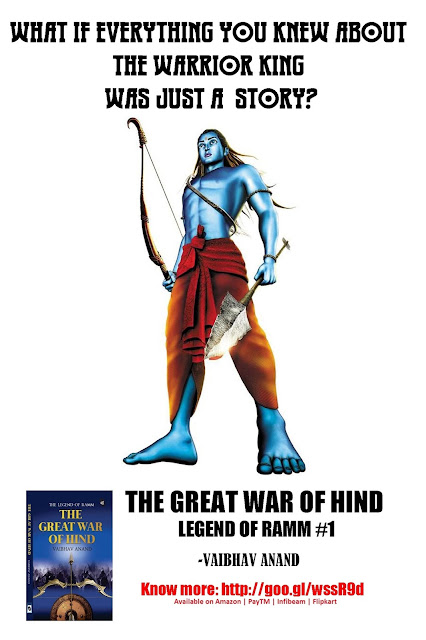
'The Great War of Hind' is my attempt to understand God and his designs on the world - why He did what He did. I had two epiphanies before I began writing the book - One, what will happen a thousand years later when archaeologists dig up Marvel's comics? Would they not think Aquaman or Spiderman were the Gods of our times? Now what if we were to extend this argument to all the mythological pieces we now... if everything that we have every been told was just a story.

Second, I like to think God despises and despised/ came to despise mankind. And so, I imagined our world thousands of years ago, where God tried to balance mankind off with demons (or animals as we know them today). Set in this mix, my story of Ramm and Hanohman and Rahvun developed slowly - known characters set in an unheard-of story.

Think of it as another episode of a childhood show, as another comic book starring your favorite childhood characters. The idea is not be in the Meluha guy's tail-wind : I wrote this book more than 2 years ago... That's how much us mere mortals sometimes need to wait to get published. (My awesome publisher had quite a backlog unfortunately.) So, I would possibly even pre-date the Ishvaku storyline.

Anyhow, it's a free country. Read what you please (ideally my book).

Or read them both and confirm my suspicions about my book being better.

Cheers!

August 30, 2015

Prologue: The Great War of Hind (The Legend of Ramm #1)

In the beginning, there was no such thing as heaven or hell. All that there was then, was earth.

I speak of a land far before time – far before the concept of time. When men and gods coexisted – lived and died and fought and loved. People thought of time in breaths and moonrises and winters; and if they missed one – say a breath or a moonrise or a winter – time simply ceased to exist. But, for the sake of chroniclers and people who shall doubt my story, I shall state that we were of twelve thousand winters before the coming of that messiah many call Yesus. 

It is unclear how everything our world as we saw it came to be. There were only stories and songs and poems passed down from generation to generation; hymns sung at festivals or lullabies that put children to sleep. 

It was said that God created man. I shall not dwell on this story for I do not know how or why or when and I will not submit myself to conjecture. All that I know is that once God created man – whichever God this was – He could no longer bear his creation. So He created a new race to destroy humankind. Having set this race upon men, God retreated to the mountains, far away from his creations. Men came to know this race by many names. In our kingdom, we called them demons.

My name is Sanjaay and I shall tell you the story of how our world came to be. There are raconteurs and mischief-mongers in our ranks and I have no doubt they shall pervert the truth with their self serving versions. The events of history – this history of our land– shall thus inevitably have many versions, doubtless. I was there with General Ramm, I fought by his side and at the very end when I left his service, and he confided in me everything – even his deepest darkest secrets. I began to write this book, this memoir of the great man that once was, when my body was no longer fit for soldiering but my mind was still robust. I travelled far and wide. I met gods and demons alike; sons and wives of men long gone – just so the world may know full well the truth about our times.

And so it was that thousands of winters ago, that earth as we knew it – as I knew it – came to be, with man and God at absolute odds.

In my time, we called our land ‘Hind’. 

A land of gods and men and everything in between. 

August 19, 2015

Acknowledgements: The Great War of Hind

It is customary, I guess, for authors to thank people. It is out of this custom alone that I thank people here; and not because of any sort of gratitude!

Jokes apart, I grew up on books. Even for our meager means, my parents never refused me a book, however expensive. My love for books has grown so much that till this day, I find it difficult to enter a bookstore and exit without a book in my hand, as also equally difficult to not enter a bookstore if I have spotted one. Thanks, thus, to my parents for buying me all those books and thanks also to those authors who have shaped my thinking and taken me to their own worlds – various, variegated and vibrant.

I must say not a day has passed after If God Went to B-School was released that people haven’t asked me and irked me with questions about my next. It is almost like people constantly pestering a newly-wed couple when they are going to have a baby. I am thus thankful for all those who asked and thus pressured me to birth this one. The labor pains were horrendous – not least because I have a mind and energy sapping day job.

Most of this book was written in the backseat of my Alto with Ram – my driver – weaving in and out of traffic on the nightmarish jam-ridden journey to office. (I bet you have never seen a ‘chauffeur driven’ Alto.) I thus attribute any and all spelling and grammatical errors to Ram’s jerky driving style. Over the past ten years in an effort perhaps to keep Delhi authors writing in the backseat of their cars, the state governments have grown road coverage by 30% while vehicles have gone up 3000%. I must thus thank profusely Delhi’s own Sheila Dikshit and that UP politician who has that big hideous expensive handbag and elephant sculptures to her credit and their respective governments as through Kanwariya, monsoon, weekly accident, traffic police barricades, ill planned road/ flyover/ metro construction, VIP movement and random inexplicable traffic jams, they have almost singlehandedly ensured that this book got written. My vote is and will forever be for you, ladies!

I am grateful to all my friends, colleagues and fellow human animals, for their stories & their banter. In no particular order- HK, MG, Avtar, KV, Vijay, Bajrangi, Anshul, Dharam, Rajat, Nauty, Sikka, Khulla, Bengali, Sartaj, Lisa, Varsha and Shilpi – people I met and befriended during my education (which is mostly fraudulent). Also thanks to all the friends I made at work (no particular order again) – KDK, Yaka, Cartoon, Sashi, Deutsch, Doshi, Doshi’s wife, Ashwin, GTJ, Rungta, Chulbul, Pratyush, Taufees (actually the entire Citi MA Batch of 2010), Monz, Shahani, Nirajana and Aman. Thanks for making me laugh and laughing at me and my jokes. And thanks for letting me observe the human animal so closely.

Thanks also to my array of friends and family members– all my masis, uncles, cousins, nephews, nieces, aunts, neighbors– all those who bought If God Went to B-School and having read it, were kind enough to say kind things about it. Several of them actually bought more than one copy of the novel, almost as if it were a collectible. Eternal gratitude.

I will also hold an eternal grudge against the many people who I presented copies of IGWTBS free of cost to and who did not read it. You are the reason I will never gift a single soul a single free copy of this one. (Good looking women might be exempted from this rule.)

Special thanks to HK who went through the various drafts of this book, kept my spirits up and most importantly, kept my cynicism in check. Well, at least she tried. Also she is, till this day, quite sure that someone is going to sue me. Eventually.

The highest praise in my mind for If God Went to B-School came from one of my mother’s best friends who told me that reading the novel was like listening to me talk. 
Sarcastic, bitter and cynical. It tells me my writing has a voice. Perhaps.

Jokes and tomfoolery aside and as always, infinitely grateful to my parents, all my teachers and God.

Best,
Vaibhav

PS: If I have missed thanking you here and you feel wronged, please do email me at vaibhav.a10@fms.edu. I’ll be sure to thank you in my next. Or to write back explaining to you in painstaking detail why I am not grateful to you. If I do not email you back, it means you have hitherto sent one too many emails with pics of cute kittens or babies or monkeys or ‘Forward this to 20 people and you will meet the love of your life near a green dumpster today’ and I have blocked your email ID. I spent one whole week at a foul smelling dumpster and no one ‘love of my life’ or otherwise ventured near me. 

It was singularly disappointing.